

From pilots to systems change in climate-smart agriculture
From pilots to systems change in climate-smart agriculture
Latest posts
Taking African food systems leadership to AFSF 2026
October 8, 2026


Strengthening maternal health systems in northern Kenya
August 18, 2026
Share:
Climate-smart practices and tech solutions are growing, yet scale remains limited. A regional analysis commissioned by the Embassy of the Kingdom of the Netherlands-Nairobi and Netherlands Enterprise Agency (RVO) explores why several of these rarely scale, and where the real challenge lies in the systems surrounding them.
Jointly authored by EKN/RVO and Wasafiri
Across East Africa, governments, development partners, and the private sector have invested significantly in climate-smart solutions; from drought-tolerant seed varieties and solar-powered irrigation to digital extension services and carbon finance pilots. Yet a familiar question persists: why, despite years of promising pilots and proven technologies, does meaningful scale remain so elusive?
Part of the challenge is that learning about what works rarely travels far enough. Successes are reported but often are not unpacked in ways that reveal why, where, or under what conditions they succeeded.
The answer, increasingly, is that climate-smart solutions are not a technology problem. It is a systems problem.
Transforming how millions of smallholder farmers manage land, water, and climate risk requires shifting the conditions that determine whether farmers can access tools, afford to adopt them, learn from each other, find profitable markets, and operate in a policy environment that rewards rather than penalises resilience.
To better understand how climate tech solutions are scaling across the region, the Netherlands Enterprise Agency (RVO) and the Embassy of the Kingdom of the Netherlands in Nairobi (EKN) commissioned a regional scoping exercise across East Africa.
The aim was to look across their project portfolio and identify the ways these practices are showing up to address climate change impacts, enhance resilience, and boost adaptation, and to ask what could be scaled or replicated.
The analysis examined programmes across Kenya, Uganda, Ethiopia, Mozambique, and Tanzania, spanning climate finance, value chain resilience, smallholder service delivery, digital agriculture, and regenerative practices. Rather than evaluating individual projects, it looked at how climate interventions interact with the wider system, and what conditions enable promising approaches to spread beyond pilot scale.
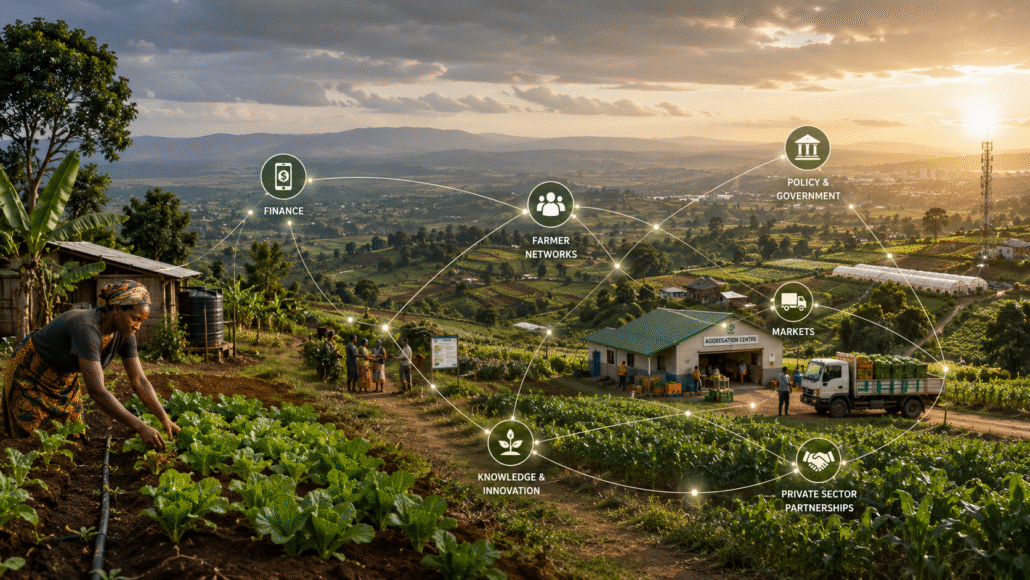
The findings showed how four systemic factors repeatedly determine whether climate-smart practices stay small or genuinely scale.
1. Finance is the gateway to adoption
The most consistent barrier to farmer adoption of climate-smart practices is not a lack of knowledge about what works. It is the inability to bear the upfront cost of change.
Whether the practice in question is improved water harvesting, climate-resilient seed varieties, biodigesters, or sustainable soil management, smallholder farmers routinely understand the long-term benefit. What they cannot always absorb is the short-term risk. The investment required before the returns materialise, in farming seasons where one poor decision can mean real hardship.
Where blended models combine grants, credit, insurance, and income linkages in ways that reduce the cost of first adoption, uptake follows. The programmes demonstrating the greatest traction are those that treat finance not as an afterthought, but as a fundamental design element of climate-smart delivery. Sustainable finance ranked as one of the six core dimensions in assessing how scalable any given approach truly is.
2. Farmer networks are the engine of learning
Climate change is, by definition, a moving target. What works this season may need adjustment next season. The practices that succeed in one agroecological zone may need re-designing in another.
Farmers who are connected to lead farmer networks, producer organisations, peer learning groups, or digitally mediated knowledge exchanges are consistently better positioned to adapt, refine, and pass on what they learn.
The most effective knowledge systems are not top-down. They are peer-driven, locally embedded, and structured to allow learning to flow both ways.
Programmes that invest in building these networks, not just as a delivery mechanism for extension, but as a genuine learning infrastructure, show measurably better outcomes in long-term adoption and resilience.
When farmers trust each other’s experience, they are more willing to try new approaches. And when those networks are connected to digital tools that capture and share what is working, the learning compounds.
3. Private sector active role is what sustains change
Development programmes can finance adoption. They cannot, by themselves, sustain it. The programmes showing the most durable results are those that have managed to align private sector incentives with climate-smart outcomes, where the commercial logic and the climate logic point in the same direction.
This alignment takes different forms. In some cases, it is agribusinesses or off-takers willing to pay a premium for produce that meets environmental or sustainability standards, giving farmers a direct market signal that climate-smart practices pay.
In others, it is input suppliers and service providers who see a commercial opportunity in serving smallholder farmers better, and who build business models that make sustainable inputs more accessible and affordable.
In others, it is blended financing arrangements that make it commercially viable for the private sector to operate in markets that would otherwise be too risky.
The common thread is that when private sector actors have a genuine commercial stake in climate-smart outcomes, the resulting change has staying power that grant-funded programmes alone cannot provide.
4. Government alignment is what enables scale
Even the most well-financed and commercially viable climate-smart initiatives will struggle to reach national scale without enabling policy. But in many East African countries, including Kenya, the policy gap is not what it once was.
Kenya has comprehensive, well-drafted frameworks for climate change mitigation, adaptation, and food security. What consistently falls short is implementation and enforcement: translating national commitments into the subnational structures, resourcing, and political will needed to create effective change.
Programmes operating in environments where governments are actively aligned with climate-smart goals, often through supportive regulation, public investment, and political commitment, achieve far greater reach than those that are not.
One biodigester initiative in Uganda illustrated this directly: a significant part of its success was the active partnership between the Ministry of Energy and the Ministry of Agriculture, whose coordinated support helped increase the adoption and availability of biodigesters in the country.
Embedding climate-smart practices within public systems, rather than running parallel to them, is consistently what gives programmes the durability to outlast any individual donor cycle.
Scaling is not what happens after a programme ends. It is what happens when a system has been changed enough that it continues to move in the right direction without external push.
Looking back
The volume and variety of climate-relevant work identified in this analysis are notable. EKN, RVO, and the Food, Nutrition, and Security teams are clearly doing serious work in this space, and perhaps the most telling indicator is how consistently climate approaches are showing up in programmes that were never explicitly designed to address it.
These are projects built around increasing productivity, market access, or value chain development that have, in practice, become vehicles for climate adaptation and resilience because the teams implementing them recognise that climate change is one of the most significant barriers standing between farmers and food security.
But the scale of what is needed means that no single development partner, however committed and however well-positioned, can drive this transition alone.
The regional analysis points to a clear conclusion: the next generation of climate-smart solution programmes must be designed with systems change in mind. That means treating finance, farmer networks, private sector incentives, and government alignment as interdependent levers that need to move together.
RVO and EKN’s commitment to understanding this landscape and to looking across the full portfolio of Dutch-funded programming and asking hard questions about what actually enables scale, reflects the kind of strategic, evidence-based leadership that the sector needs more of.
Image generated using AI on ChatGPT.

