The African Food Fellowship on October 24 2025 hosted the annual Kenya Transform Food Festival in Nairobi, Kenya. The gala event brought together food systems leaders working in governments, private sector, research and academia, financing, civil society, and community groups to celebrate leadership as an essential catalyst for transforming food systems in Kenya.
Through a series of well curated sessions and inspiring speakers, the festival showcased food systems leadership in action, and celebrated those who have made great strides to build collaborations and work towards a common goal.
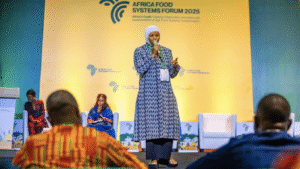
Food 4 Education senior policy manager Stella Kimani delivers a keynote speech at the festival.
“Food systems transformation is not just theory but applied courage. It’s adaptive, collaborative, and grounded in the belief that Africans can design and scale solutions to Africa’s problems,” said Food 4 Education senior policy manager Stella Kimani, who delivered the keynote speech.
Stella, who is also an African Food Fellow, challenged the audience to lead with courage.
“We start at the intersection of possibility and responsibility. Your leadership matters. Our continent does not need heroes but architects of systems who build bridges between generations and ideas. Let’s keep experimenting, collaborating and leading with courage,” she said.
Africa’s food systems are at a pivotal moment and provide big opportunities for change and transformation. With the CAADP Kampala Declaration signed in January this year, Africa reaffirmed its commitment to end hunger by 2035 by increasing sustainable agricultural production, tripling inter-Africa trade in agro-food items, and reducing post-harvest losses.
Africa’s food systems are intricately entwined in a complex web of factors, including climate volatility, governance, trade, technology, cultural norms, and economic inequities. By design, these challenges defy one-size-fits-all solutions. Food systems leadership becomes indispensable in diagnosing these intertwined issues and orchestrating collective action.
The Kampala Declaration recognises this and notably differs from previous agreements by moving away from focusing on technical interventions and quantitative metrics to enhancing food system approaches and embracing inclusive design and implementation processes. Simply put, it signals a strong intention to put people at the centre of food systems transformation.
Happy smiles! Guests enjoy conversations and finger foods during the festival.
The festival honoured this intention by offering an opportunity for Fellows to showcase their food systems actions, which are initiatives that they are working on to secure real impact on the ground. They demonstrated how they have used collective leadership to unlock public private partnerships for healthy school meals and inclusive value chains, bridge the data gap in the aquaculture sector, and merge aquaculture and horticulture systems in the arid lands.
African Food Fellowship Kenya FSA Lead Ledama Masidza (far left) leads Fellows Stephen Muthui, Proscovia Alando and Salash Leshornai in a panel discussion on their Food System Actions.
“Where I come from, the climate is changing faster than culture. Pastoralism on its own is not a viable source of income for communities in ASAL regions. This is why we are setting up a learning hub to teach communities a new way of securing their livelihoods and nutritious diets for everyone,” said Salash Leshornai, who is working with Kelvin Muli and Robert Shumari to introduce integrated Aquaculture–Horticulture Systems (Aquaponics) in Kajiado and Samburu counties. This is a climate-resilient alternative which demonstrates that a nutritious plate can be locally secured—fish for protein and vegetables from the kitchen garden—even in the dry season.
Fellow Robert Shumari elaborates on the Aquaculture Learning Hub model and its intended impact.
On their part, Fellows Proscovia Alando, Mary Opiyo, Alice Hamisi and Ruth Lewo demonstrated how they are bridging the date gap in the aquaculture industry to ensure that women’s contributions are more visible and can therefore attract more support.
“Through data, we are connecting farmers with the necessary support so that the information we collect can give actionable insight to not only improve farmers’ business but strengthen food security. We involve a diverse set of actors. We connect the farmers to financiers, insurance providers, input providers, and markets,” they said.
Fellows Alice Hamisi and Proscovia Alando (right) interact with guests curious to learn more about their work in making women in aquaculture more visible.
The evening culminated in the awarding of the Food System Action prize, which went to Feeding Futures, and initiative designed by Fellows Julia Kamau, Sylvia Kuria and Stephen Muthui to deliver nutritious indigenous meals to school children in Kenya’s informal settlements. Due to limited space in government-sponsored schools, these children attend alternative private schools which receive no formal support from the government, including the school feeding programme.
“We envision a country where all children have access to organic and healthy food. This is a right in our constitution, so we’re not coming. to do a favour for these children but ensuring their rights are protected,” said Stephen, who represented the group at the award ceremony.
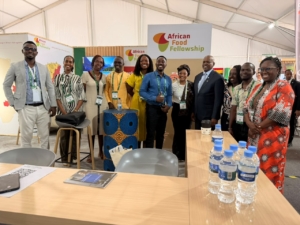
Food System Action award winner Stephen Muthui (third from left) poses for a picture with Fellows and members of the AFF secretariat.
Guests also had a n opportunity to interact with the latest research by the African Food Fellowship which provides evidence that leadership is a catalytic force that turns good ideas into a systems-changing interventions. Food systems leadership enables collective action and brings multiple stakeholders to the table, including the people most marginalised by the existing system, to become co-designers, implementors, and advocates of the solution.
“At the African Food Fellowship, we curate the conditions for people to collaborate and act. We need to change behaviour, shift power dynamics, secure investments and incentives, and influence policy. That’s a human-centered approach,” said the African Food Fellowship head of networks and delivery Claudia Piacenzia.
https://wasafirihub.com/wp-content/uploads/2025/10/Kenya-transform-Food-Festival-2025-428-1024x684-1.jpg6841024Jacqui Kubaniahttp://u05.88f.myftpupload.com/wp-content/uploads/2018/08/Wasafiri-LOGO-1.pngJacqui Kubania2025-10-27 14:12:102025-10-27 14:26:19Kenya Transform Food Festival 2025: Leading differently to transform food systems



 Why COP30 must centre food systems