When you meet Ledama Masidza, you quickly sense his deep bond with the ocean.
A Marine Conservationist, Indigenous Food Systems Advocate, and natural storyteller, he has dedicated his young and impressive career to working with fishing communities to restore balance between livelihoods and marine life.
Among his proudest achievements is helping secure user rights for a 12,000-hectare co-managed marine area on Kenya’s coast, an effort that has drawn global attention.
Ledama’s journey into conservation began in his childhood, watching how coastal communities depended on the ocean for survival while struggling to keep it alive. That early awareness grew into a passion he carried through university and into his first role in Kuruwitu, a small fishing village in Kilifi County. It was there, he says, that “the ocean became my first classroom in leadership.”
In this conversation with Stella Odhiambo, Ledama shares what he learned in Kuruwitu, why community ownership matters, and how applying a systems approach reveals that youth and local communities already hold the keys to lasting solutions.
Ledama filming for an upcoming documentary
What first drew you to working with the ocean and coastal communities?
The ocean was my first classroom in leadership. Right after graduating, I found myself in Kuruwitu, a small coastal village in Kilifi County, some 36 or so kilometres from Mombasa, Kenya.
I was working as an environmental program manager, supporting a 30-hectare Locally Managed Marine Area. I would spend long hours restoring coral, doing research, and filming this incredible sanctuary.
Inside, life flourished. Outside, I would find discarded nets, turtles trapped, and reefs stripped bare. It broke my heart. I knew we couldn’t only protect small pockets of ocean…we had to restore the wider seascape. And that could only happen with the community fully in the lead.
What was happening in Kuruwitu’s fisheries, and why was change so urgent?
By 1999, the Kuruwitu fishery had collapsed. 5,000 metric tonnes of fish gone. Regulations existed but were weakly enforced. Beach Management Units, which were supposed to lead governance, had no resources, no training, no leadership support. And unlike land, the ocean has no title deeds.
Fish swim across boundaries. How do you secure tenure over food that moves? That reality pushed me to see conservation differently: you can’t eat conservation. Real conservation is about both biodiversity and livelihoods.
Families were struggling. Fishers would go out to sea and return empty-handed. Young people had little reason to see fishing as a viable future. Without urgent action, both culture and ecology were at risk. That urgency forced us to ask: what would it take to build a community-led system that lasts?
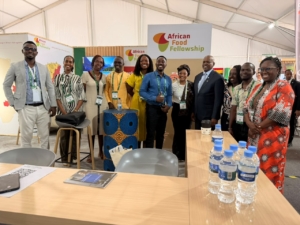
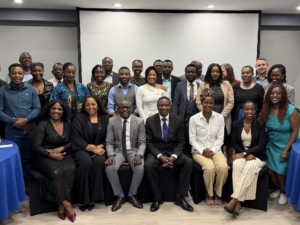
Ledama graduating from the African Food Fellowship
Building a functional, community-led governance system sounds complex. At Wasafiri, we use Systemcraft as a way to make sense of such change. Did you see this approach at play in Kuruwitu?
Absolutely. Supported by Oceans Alive and the Kuruwitu Beach Management Unit, the steps we took align closely with the five dimensions of Systemcraft. My understanding of this approach deepened when I became a fellow of the African Food Fellowship and saw these same dimensions applied not just to oceans, but to food systems across Africa. I saw it lead to real environmental impact.
It began with organising for collaboration. The Beach Management Unit needed legitimacy. So I helped them hold elections. Yes, 21-year-old me! We had to update their constitution and secure legal standing. Without that collective structure, nothing else could have taken root.
Then we had to set the direction. Mapping the fishing grounds with researchers gave the community a clear picture of their territory. Seeing it on a map created a shared sense of responsibility: this is ours to protect.
From there, we turned to harnessing collective intelligence. Not so simple when wary NGO’s refused to share their data with us. We were looking at 1-year-old studies. So we carried out new surveys with fishers, co-creating a baseline of data. This wasn’t abstract research; it was knowledge the community could use to guide decisions.
To make it matter, we brought everyone into the process. I’ll never forget taking stakeholders snorkelling: inside the sanctuary, the reefs teemed with life; outside, they were barren. That single experience spoke louder than any report. I believe it fanned a shared urgency for action.
Finally, we had to change the incentives. Together, the community drafted bylaws on fishing gear, enforcement, and surveillance. It wasn’t easy – because in truth, a broken system works for some people or some of the time. There was definitely some resistance to change, and debates often grew heated. But over time, the rules began to shift behaviours, rewarding stewardship over short-term gain, and giving fishers a reason to protect rather than exploit.
And when the government granted official recognition, it brought us full circle to collaboration again. This time on a larger scale. The community now had both the authority and the partnerships to act as true stewards of their ocean.
Ledama at the Africa Youth Summit in 2024
Why is community ownership essential for lasting conservation solutions?
Because only the community can balance survival with stewardship. Outsiders may bring funding or science, but if families go hungry, no project will last. Ownership transforms conservation from an external agenda into a practice rooted in culture and livelihood.
What lessons from Kuruwitu can be applied to wider food systems?
The lesson is this: solutions already exist within communities. Youth and local leaders know their realities better than anyone else. With space, knowledge, and resources, they can transform entire systems, whether fisheries, forests, or food systems.
You’ve described this process as "Collective System Action." How does that link to your approach today?
Collective System Action means no single project or actor can drive transformation alone. Change requires shifting incentives, coordinating coalitions, setting clear direction, making it matter to people’s lives, and continuously learning. That’s what we lived through in Kuruwitu. It wasn’t a linear project; it was a systems journey.
Ledama at COP28
Looking ahead, why do you believe global solutions can and should come from Africa?
Because we’ve already shown it’s possible. What started in Kuruwitu became a model shared at the World Conservation Congress and at COP. From there, it inspired adoption at different levels: by organisations such as African governments and the African Protected Areas Congress at a continental scale, and by global bodies through platforms like Nature Seychelles and the World Conservation Congress.
Today, I co-founded the Local and Indigenous Food Systems Transformation Network (LIFT), connecting communities across continents. Turns out the ideas born on an African coast, a small fishing village, can inspire the world.
In conclusion, systems thinking is not an abstract theory. It is a living, adaptable practice. What Ledama helped build in Kuruwitu shows that communities and youth hold the keys to solving global challenges, starting right here in Africa.
If you’re grappling with a complex social issue and want to understand our approach Systemcraft a little better, see what our easy to grasp, self-led course is all about here: Systemcraft Essentials course by Wasafiri
https://wasafirihub.com/wp-content/uploads/2025/09/MandaDay2-40.jpg534800Ledama Masidzahttp://u05.88f.myftpupload.com/wp-content/uploads/2018/08/Wasafiri-LOGO-1.pngLedama Masidza2025-09-04 23:41:552025-09-09 13:21:48What a fishing village taught me about transforming complex systems




 Kenya Transform Food Festival 2025: Leading differently to transform food s...